
Past Development
This segment will discuss how my past courses and activities have developed my Expertise Areas, Designer Skills, Design and Research Processes, and Professional Identity and Vision.
BUSINESS & ENTREPENEURSHIP
I began to build a foundation in Business & Entrepreneurship through courses such as Introduction to Business Design and Design Innovation Methods; I learned how to utilize a range of business canvases that enable me to understand the complex relationship of stakeholders and provide a clear overview of business structures. For example, I conducted a business analysis for an app called Grosharies, which I developed during the Engineering Design course; I employed a Business Model Canvas and Onion Map to provide a contextual overview of stakeholder relations; Thereafter, I identified product limitations and solutions using a Value Proposition Canvas and Problem Solution Fit Canvas. This can be especially useful to optimize business practices or to communicate business developments to stakeholders.
Moreover, during my internship at vanPlestik, I was able to experience business operations in practice; Starting with a clear company identity and vision, key partners, resources, activities, and customer relationships. I was in close contact with the Business Operations Manager and Marketer, where I could observe client meetings, and partake in design exhibitions. A part of my vision and goals is to one day set up my own company or design studio; and my business and entrepreneurship foundation has certainly given me more confidence in my capabilities to do so.
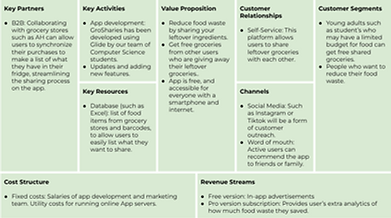
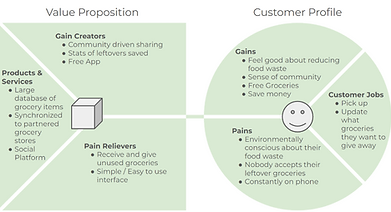
GroSharies App - Business Canvases
CREATIVITY & AESTHETICS
One of my first courses, Idea to Design, introduced me to design processes and ideation methods, such as rapid ideation techniques, storyboarding, and brainstorming. Moreover, an important aspect of ideation and communicating design concepts is through illustration, which I have improved my skills through the Exploratory Sketching course.
I challenged my notions on the boundaries of Creativity and Aesthetics during the Aesthetics of Interaction course; During an Interactive Materiality lecture I learned about incorporating multisensorial elements as part of creating an aesthetic experience. This can be seen in my Mushroom Mantra project, where I incorporated texture, haptic sensation, smell, and sound to create a multisensory wake up experience. This multisensory approach inspired me later to pursue my FBP in the Sensory Matters squad.
Additionally, one of my goals was to make high-fidelity and professionally presented products, which I have also had the chance to practice during my internship at vanPlestik; One of my roles was production and post-processing. This taught me how to make products that are aesthetic, and ready to be presented at exhibitions or commercially sold.
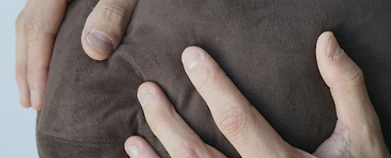
Mushroom Mantra - Multisensorial Touch
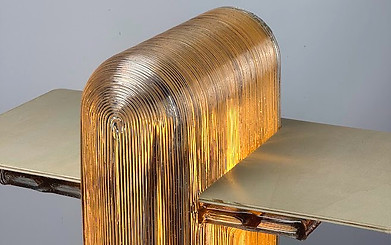
vanPlestik Internship - Shelf Design
MATH, DATA & COMPUTING
I developed a basis of programming by learning how to use Processing, based on Java, through courses such as Creative Programming and Creative Electronics. Moreover, I learned how to compute and process large collections of data with Python using Jupyter during Data Analytics and Making Sense of Sensors courses.
Developing the basis of programming skills proved useful later on when I took the advanced elective course Intelligent Interactive Products, where I learned how to apply machine learning algorithms to train data and create prototypes; I developed WSAT, a smartwatch that uses posture recognition to keep track of user activity during work sessions, encouraging good posture, and limit distractions from phone usage. Additionally, I worked on Boxi, a smart safe that uses a combination of biometric sensors; It detects facial recognition, voice recognition and physical interaction patterns to create a multi-step user verification process to unlock the safe.
The more I developed my Math, Data and Computing expertise, the more I realized how useful it can be for applying to other expertise areas, such as using programming for Technology and Realization or data processing for Business and Entrepreneurship.
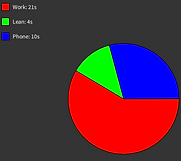
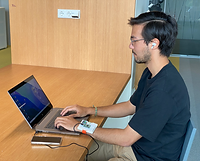
WSAT - Activity Tracker
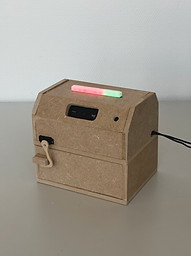
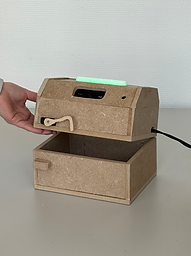
Boxi - Locked & Open state
TECHNOLOGY & REALIZATION
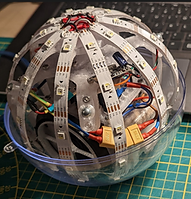
Realizing designs into products involves combining other expertise areas. For example, during Project 2 I worked on Lumesphere, an interactive light orb to enhance shared experiences and awareness in shared spaces. Lumesphere was designed for the context of a speculative family household in the future (User and Society). The light orb can change in color, shape and size based on the user interaction to reflect their mood (Creativity and Aesthetics). A functioning prototype was built that incorporated electronics and sensors, enabling the light orb to freely roll around the household to return to its homing location (Technology and Realization).
As mentioned earlier in the previous expertise area segments, my vision is to one day set up my own company or design studio. Hence, I had the goal of gaining experience in presenting my products in an aesthetic and professional way. Moreover, this gave me the target to realize a high-fidelity product for my FBP, that incorporates multiple expertise areas.
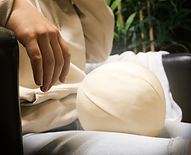
Lumesphere
Lumesphere
- Interior
USER & SOCIETY
I became a user-centered designer as I recognized the importance of user experience and societal context. Courses such as User-Centered Design provided me with design and research process methods including Personas, Storyboard Scenarios and Semi-structured Interviews. These methodologies enable a deeper understanding of users, and ensure that their needs and wishes are considered throughout the design process. Moreover, the Human Factors course taught me how human perception and models of cognition play a role in designing interfaces.
Additionally, in the scope of societal context, I have developed my expertise on sustainability design perspectives through several courses. The ID Green elective introduced me to sustainable frameworks, such as the Waste Hierarchy and Circular Economy; I utilized these frameworks later in my Project 1, which focused on upcycling a waste-stream material to develop a mesh fabric for clothing. Moreover, the Design for Debate course expanded my design perspectives to consider non-human perspectives, agencies, biographies, and nomadic practices. These courses later inspired me to put sustainable design into practice by doing an internship at vanPlestik. VanPlestik is a sustainable furniture company that uses 100% recycled plastics that have been shredded to create chairs, tables, vases and lampshades, using large industrial 3D printers.
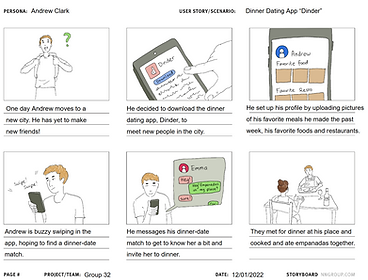
UCD Dinder App - Storyboard
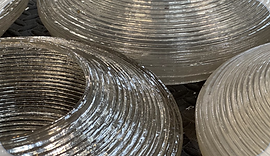
vanPlestik
- Lampshades
DEVELOPMENT OF PROFESSIONAL IDENTITY AND VISION
Looking back on the past few years, I have explored a diverse variety of subjects. I have developed and changed a lot as a designer, as this experience taught me more about myself and where my interests lie. When I started my studies in Industrial Design, I was initially motivated towards designing smart technology products. I was inspired by companies such as Apple, where I first heard of their famous “Industrial Design Team” led by Jony Ives in the past; I envisioned myself working in a similar field, designing smartphones or VR goggles. Hence, my personal development plan had goals to learn how to program, work with electronics, and 3D model. I achieved some of these goals through courses such as Creative Programming and Creative Electronics. However, after joining ID Green, I also developed an interest in learning more sustainable practices.
Starting the second year of my studies, I had a newfound vision of adapting sustainable practices to my designs. This led me to pursue courses such Design for Debate, and the Design for a Sustainable Future USE track. Moreover, I continued to apply sustainability frameworks and design concepts in other courses as well.
By my third year, my focus shifted away from smart technology, and more towards general product design. I wanted to develop myself to become a flexible and multidisciplinary designer who is able to make high-fidelity products. Therefore, to gain experience in production and manufacturing, whilst still applying sustainable design to practice, I decided to do an internship at vanPlestik, a sustainable furniture company.